CITED
An answer engine cites a handful of sources per question, and nobody can see which ones they are, why those pages win, or what would have to change on their own page.
Architecture
Overview
CITED asks six real answer engines the questions buyers in a category actually type, records every source each engine cites, explains why the winning pages win, and writes the fixes for the client's page. It was built for the Precis technical case in July 2026, and the hosted board replays a recorded panel so a public URL does not spend money on every visit.
How it works
Five of the engines are reached through an Apify actor, Google AI Overview, Google AI Mode, Perplexity, ChatGPT search and Gemini. Claude is called directly on the Anthropic Messages API with its web search tool, which makes it the only first-hand read of the six. Each answer is parsed for the sources it names and the order it names them in, so a domain gets a reach across engines rather than a single rank.
The audit then scores a page on nine factors, writes the rewrite plan, and re-tests the same questions against the same competing sources. Every rewrite that needs a figure, a study or a named person leaves a visible slot and is counted as refused rather than invented.
Why I built it
The first version asked a model which sites it would cite. That is a model describing its own imagined behaviour, one site per question and nothing anyone can check. Replacing it with live calls to the engines is what turned the build into something a client can verify, because every export can be re-checked by retyping the question into ChatGPT and reading the source list.
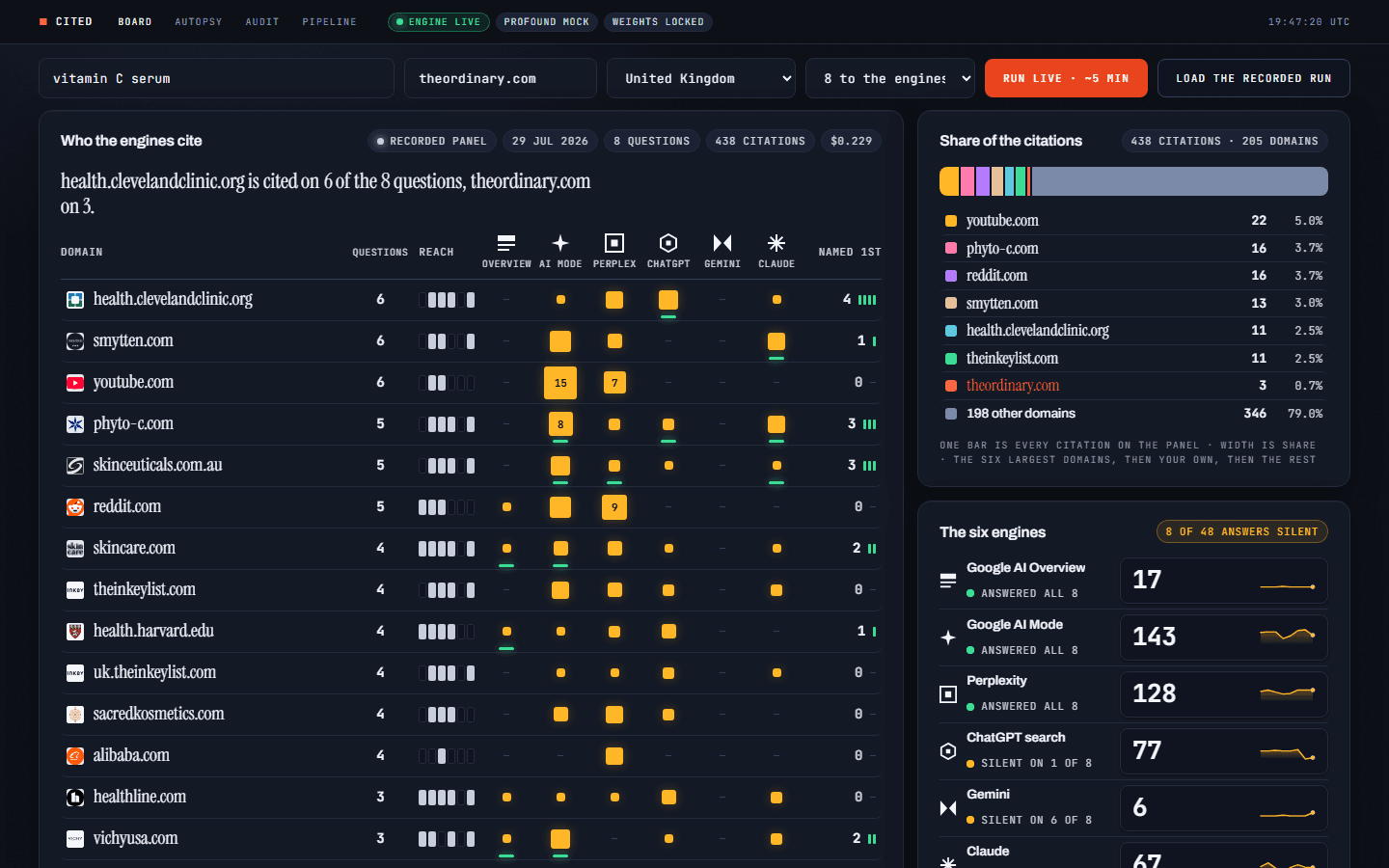
The measured run on 2026-07-28 cost $0.0985 for four questions across six engines, about four minutes, and returned 254 citations over 136 domains. On the recorded panel shown on the board, eight questions returned 438 citations across 205 domains for $0.229.
What it refuses to claim
The number that moves is the count of questions where the page is cited, measured on the same engine against the same competing sources, before and after the fixes. On the bundled fixtures that went from two of five to five of five. It stays a controlled comparison rather than a promise about production ChatGPT, since live citation also depends on the engine's own index and retrieval, which nobody outside the vendor controls.
Try it
Open the board and load the recorded run, which is the real output of a real run on vitamin C serum in the United Kingdom. Pick any domain in the table, retype one of the eight questions into ChatGPT, and check the source list yourself.